
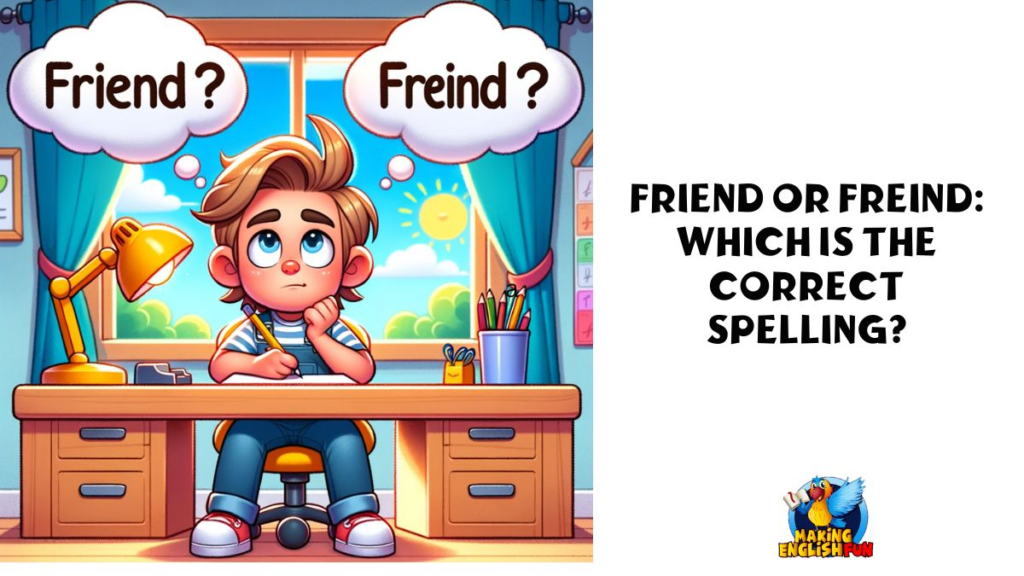
The correct spelling is friend.
Freind is an incorrect spelling and is one of the most common spelling mistakes people make when writing the word friend. Although freind may look natural because of the way the letters sound when the word is pronounced, it does not follow the standard spelling of the English word.
The word friend is a noun that refers to a person you know, like, trust, or have a friendly relationship with. It can also be used in broader ways to describe someone who supports another person, group, organization, or cause.
For example:
- She is my best friend.
- I met an old friend yesterday.
- He has been my friend since childhood.
- My friend helped me with my homework.
- We became close friends in college.
The incorrect form freind often appears because people accidentally place the i and e in the wrong order. Similar mistakes include frend, firend, frind, friemd, friand, and frient.
Understanding the correct spelling becomes easier when you learn the word as a whole instead of trying to spell it only from its pronunciation.
The simple rule to remember is:
Friend = correct
Freind = incorrect
This distinction matters in school assignments, professional emails, resumes, social media posts, business communication, and everyday writing. While readers can often understand what someone means when they write freind, the spelling is still considered incorrect in standard English.
What Does Friend Mean?
The word friend means a person with whom you have a relationship based on affection, trust, support, shared interests, or mutual respect.
A friend can be someone you have known for many years, or it can be someone you met recently. Friendships can develop at school, at work, in a neighborhood, through hobbies, online communities, sports, or other shared activities.
For example:
“My friend lives near my house.”
In this sentence, friend refers to a person who has a friendly relationship with the speaker.
The word can also describe a person who supports someone or something.
For example:
“She is a friend of the local library.”
Here, friend does not necessarily mean a close personal relationship. It can mean someone who supports or has a positive connection with the library.
The plural form is friends.
For example:
“I have many friends.”
The possessive form can be friend’s or friends’, depending on the meaning.
For example:
“My friend’s car is outside.”
This means the car belongs to one friend.
“My friends’ cars are outside.”
This means the cars belong to more than one friend.
The word friendship refers to the relationship between friends.
Also read:Receive or Recieve:Which One Is Correct?
For example:
“Their friendship has lasted for many years.”
Is Friend or Freind Correct?
Friend is the correct spelling.
Freind is a misspelling.
This is true whether you are writing formal English, casual English, American English, or standard written English.
Correct:
“I called my friend last night.”
Incorrect:
“I called my freind last night.”
The difference is only one letter position, but that small difference changes a correctly spelled word into a spelling error.
Many people search for freind because they remember the word’s letters incorrectly. Search queries such as frend, firend, frind, friemd, and freinds are also common examples of attempts to spell friend.
These forms may appear in informal messages, comments, usernames, search queries, or quick typing. However, they should not be used in carefully written English.
Why Do People Confuse Friend and Freind?
The main reason people confuse friend and freind is the order of the vowels.
The correct spelling is:
F-R-I-E-N-D
The common misspelling is:
F-R-E-I-N-D
The i and e are reversed in freind.
This mistake is understandable because English spelling does not always match pronunciation in a simple way. When people hear friend, they may not immediately know whether the middle letters should be ie or ei.
There are also other familiar English words that contain ei, such as receive, ceiling, and their. Because English has many spelling patterns, writers sometimes transfer one pattern to another word.
Another reason is typing speed. When people type quickly, they may know exactly what they want to say but accidentally switch two letters.
For example, someone might type:
“She is my freind.”
The writer usually knows that the person is a friend. The mistake is simply a spelling error.
An Easy Way to Remember the Spelling of Friend
One simple memory trick is to remember the word as “fri + end.”
Friend contains the letters:
FRIEND
You can visually divide it like this:
FRI + END
The word starts with “fri” and ends with “end.”
Thinking of the ending “end” can help you remember that the middle sequence is “ie,” not “ei.”
Another useful trick is to connect friend with friendship.
Friend:
F-R-I-E-N-D
Friendship:
F-R-I-E-N-D-S-H-I-P
If you remember the correct spelling of friendship, you can use the same beginning to spell friend.
You can also practice writing a short phrase several times:
“My friend”
“My best friend”
“My close friend”
“My old friend”
“My childhood friend”
Repeated exposure makes the correct spelling easier to remember.
How Do You Pronounce Friend?
Friend is pronounced approximately like “frend.”
In American English, the pronunciation is commonly represented in the International Phonetic Alphabet as /frɛnd/.
The vowel sound is similar to the vowel sound in words such as “bed” and “send.”
This creates an important spelling point: the word sounds closer to “frend” than the spelling friend might suggest to a learner.
However, the pronunciation does not change the spelling.
You pronounce the word approximately as “frend,” but you write it as friend.
That is why frend is not the standard spelling even though it may look like a logical spelling based on sound.
For example:
Correct spelling: friend
Approximate pronunciation: frend
Incorrect spelling: frend
This difference between spelling and pronunciation is common in English. Many English words cannot be spelled accurately simply by writing the sounds you hear.
Friend Meaning in Simple English
In simple English, a friend is someone you like and with whom you have a positive relationship.
A friend may be someone who:
- spends time with you
- listens to you
- helps you
- shares interests with you
- supports you
- communicates with you
- enjoys activities with you
- cares about your well-being
For example:
“Mike is my friend.”
This means Mike and the speaker have a friendly relationship.
The strength of a friendship can vary. Someone may be a casual friend, close friend, best friend, childhood friend, online friend, or longtime friend.
Friend as a Noun
The most common grammatical use of friend is as a noun.
A noun names a person, place, thing, or idea. Friend is a noun because it names a person who has a friendly relationship with another person.
Examples include:
- My friend called me.
- Sarah is a good friend.
- He introduced me to his friends.
- I saw an old friend at the store.
- My best friend lives in Texas.
In each sentence, friend or friends identifies a person or group of people.
Friend as a Verb
Friend can also be used as a verb, especially in modern digital and social media contexts.
To friend someone means to add that person to a social networking connection or friend list.
For example:
“She friended me on the social media app.”
This use developed from the noun friend and is common in informal digital communication.
However, the spelling remains friend. It does not become freind.
Friend vs Friendship
Friend and friendship are related but have different meanings.
Friend usually refers to the person.
Friendship refers to the relationship.
For example:
“John is my friend.”
This identifies John.
“John and I have a strong friendship.”
This describes the relationship between John and the speaker.
The word friendship is formed from friend plus the suffix -ship.
Examples:
- Their friendship is strong.
- We developed a close friendship.
- Childhood friendship can last for decades.
- Their friendship began at school.
A common misspelling is freindship or frendship. These forms are incorrect.
The correct spelling is friendship.
Common Misspellings of Friend
Friend is frequently misspelled because the word contains an unusual vowel arrangement and because its pronunciation does not clearly reveal its spelling.
Some common incorrect forms include:
- freind
- frend
- firend
- frind
- friemd
- friand
- frient
- frendd
- friendd
- freindd
- frendz
- frnds
- frnd
- frends
- freinds
- freindship
- frendship
- frendly
- freindly
- friendy
Most of these forms are simple typing or spelling errors.
Some forms, such as frnd and frnds, may also be intentional abbreviations used in texting. Even when they are understandable in casual messages, they are not standard spellings for formal writing.
Freind Meaning: Is It a Word?
Freind is not the standard English spelling of the word friend.
When people search for “freind meaning,” they are usually looking for the meaning of friend or trying to confirm whether freind is correct.
The intended word is almost always friend.
For example:
“She is my freind.”
The correct version is:
“She is my friend.”
The meaning remains the same, but the spelling needs to be corrected.
Frend: Is This Correct?
Frend is another common misspelling of friend.
It may seem reasonable because friend is pronounced approximately like “frend.” However, English spelling is not always based directly on pronunciation.
Therefore:
Frend = incorrect standard spelling
Friend = correct spelling
For formal writing, always use friend.
The same applies to plural forms. Frends is incorrect, while friends is correct.
Firend: Why Is It Incorrect?
Firend is another letter-order mistake.
The correct word is:
friend
The incorrect form is:
firend
In firend, the letters i and e appear in the wrong positions, and the spelling pattern becomes unfamiliar.
This is often an example of a transposition error, where two letters are accidentally switched.
For example:
Correct: friend
Incorrect: firend
Correct: friends
Incorrect: freinds
The best way to avoid this problem is to memorize the sequence “friend” instead of relying only on sound.
Frind and Other Short Misspellings
Frind is another incorrect form of friend.
It removes the e from the standard spelling.
Similarly, frnd is a shortened form often seen in texting.
For example:
“Hey frnd, how are you?”
This may be understood in casual online communication, but it is not appropriate for professional writing.
In a professional email, use:
“Hello, my friend.”
rather than:
“Hello, my frnd.”
The context matters. Informal texting often allows abbreviations, but formal English requires standard spelling.
Friemd and Other Typing Errors
Friemd is a less common but understandable typing error. In this form, the letters in the middle and ending are altered.
Other unusual forms may include friand, frient, friendd, and freindd.
Also read:Believe or Beleive:Which One Is Correct?
These errors often happen because the writer is typing quickly, does not proofread, or has not learned the standard spelling.
The solution is simple: compare the word with the correct spelling friend.
Friend and Friends: Singular vs Plural
Friend is singular.
Friends is plural.
Use friend when talking about one person.
Example:
“She is my friend.”
Use friends when talking about two or more people.
Example:
“They are my friends.”
The difference is the letter s at the end.
Correct:
- one friend
- two friends
- many friends
- my friend
- my friends
Incorrect:
- one friends
- two friend
The plural form is especially important because people sometimes write freinds instead of friends.
Freinds is incorrect.
Friends is correct.
Friend or Friends in Common Sentences
Here are some simple examples:
“My friend is coming over.”
“My friends are coming over.”
“She has one close friend.”
“She has several close friends.”
“I met my friend’s family.”
“I met my friends’ families.”
Learning these patterns helps writers use the word correctly in both spelling and grammar.
Best Friend or Best Freind?
The correct phrase is best friend.
For example:
“She is my best friend.”
Best freind is incorrect.
People often type best freind because the word friend itself is misspelled.
Correct:
“My best friend lives nearby.”
Incorrect:
“My best freind lives nearby.”
The phrase best friend is very common in everyday English, especially when talking about a person with whom you have a particularly close relationship.
My Friend, My Freind, and My Frend
“My friend” is correct.
“My freind” is incorrect.
“My frend” is incorrect.
Examples:
Correct: “My friend helped me.”
Incorrect: “My freind helped me.”
Incorrect: “My frend helped me.”
The phrase my friend is one of the most common everyday uses of the word, so learning it as a complete phrase can help reinforce the correct spelling.
Close Friend vs Close Freind
The correct phrase is close friend.
For example:
“He is a close friend of mine.”
Close freind is a misspelling.
You may also see close frend in informal searches or messages. However, the standard spelling remains close friend.
A close friend is someone with whom you have a strong personal relationship.
For example:
“She has been my close friend for many years.”
Good Friend vs Good Freind
The correct spelling is good friend.
For example:
“He has always been a good friend to me.”
Good freind is incorrect.
A good friend is generally someone who is supportive, trustworthy, kind, respectful, or dependable.
The phrase can describe different kinds of friendships depending on the context.
Online Friend and Virtual Friend
Modern communication has created phrases such as online friend and virtual friend.
An online friend is someone you know primarily through the internet or digital communication.
A virtual friend can have a similar meaning, although the exact meaning depends on context.
Examples:
“I met my online friend through a gaming community.”
“My virtual friend lives in another state.”
These phrases are increasingly common because people form social connections through games, forums, social networks, messaging platforms, and online communities.
The spelling remains friend, regardless of whether the friendship happens online or in person.
Therefore:
online friend = correct
online freind = incorrect
virtual friend = correct
virtual freind = incorrect
Fake Friend vs True Friend
The expressions fake friend and true friend are often used when describing the quality of a friendship.
A fake friend is someone who appears to be a friend but may not genuinely care about or support another person.
A true friend generally refers to someone who is sincere, supportive, trustworthy, and loyal.
Examples:
“She realized that he was a fake friend.”
“He proved that he was a true friend.”
The misspellings fake freind and true freind are incorrect.
The correct forms are fake friend and true friend.
Childhood Friend and Old Friend
A childhood friend is someone you became friends with when you were a child.
For example:
“Alex is my childhood friend.”
An old friend is someone you have known for a long time or someone you have not seen for a long period.
For example:
“I ran into an old friend at the airport.”
The phrases childhood freind and old freind are incorrect because freind is not the standard spelling.
Correct:
childhood friend
old friend
Incorrect:
childhood freind
old freind
Friend vs Friendly
Friend and friendly are related words, but they do not mean exactly the same thing.
Friend is a noun.
Friendly is an adjective.
A friend is a person.
Friendly describes behavior, personality, or an atmosphere.
For example:
“Tom is my friend.”
Here, friend is a noun.
“Tom is very friendly.”
Here, friendly is an adjective describing Tom’s personality.
The correct spelling is friendly.
Common misspellings include frendly and freindly.
These forms are incorrect.
Correct:
friendly
Incorrect:
frendly
Incorrect:
freindly
What Does Friendly Mean?
Friendly means kind, pleasant, welcoming, helpful, or behaving like a friend.
For example:
“The staff were friendly.”
“She gave me a friendly smile.”
“The neighborhood is friendly and welcoming.”
The word friendly is related to friend, but you should not spell it by simply changing the spelling of friend incorrectly.
The correct sequence begins with friend:
friend + ly = friendly
The spelling remains friend before the ending is added.
Friendy vs Friendly
Friendy is an incorrect spelling of friendly.
The correct word is friendly.
Correct:
“The teacher was friendly.”
Incorrect:
“The teacher was friendy.”
Although friendy might look like a shortened version of friendly, it is not the standard English spelling.
This is another reason it is useful to recognize common word families.
Friend
Friends
Friendly
Friendship
Friendship and friendly both begin with friend.
Friend and Friendship Word Family
Understanding related words can make spelling easier.
The main word family includes:
- friend
- friends
- friendship
- friendly
- friendlier
- friendliest
- befriended
- befriending
- befriend
All of these forms are connected to the idea of friendship or friendly relationships.
Common misspellings can affect the whole word family.
For example:
friendship → correct
freindship → incorrect
frendship → incorrect
friendly → correct
freindly → incorrect
frendly → incorrect
friend → correct
freind → incorrect
Learning the root word friend can therefore help improve spelling across several related words.
Friend vs Freind in Formal Writing
In formal writing, always use friend.
This includes:
- school assignments
- college papers
- job applications
- resumes
- professional emails
- business documents
- reports
- articles
- websites
- presentations
- official messages
Even though spelling mistakes like freind are usually easy to understand, they can make writing look less polished.
For example, compare:
“I am grateful to have a good friend who supports me.”
with:
“I am grateful to have a good freind who supports me.”
The first sentence looks professional and correct. The second contains an obvious spelling error.
Proofreading is especially important in professional communication because small mistakes can affect the reader’s impression of the overall writing.
Friend in American English
Friend is spelled the same way in American English and British English.
There is no American spelling variation in which freind becomes acceptable.
Both major varieties use:
friend
friends
friendship
friendly
Therefore, if you are writing for a US audience, the correct spelling is still friend.
Why Pronunciation Does Not Change the Spelling
English contains many words whose pronunciation does not perfectly reveal their spelling.
Friend is a good example.
The word is pronounced approximately like “frend,” but the written form contains ie.
This means you should not try to spell every English word only according to how it sounds.
For example:
friend is pronounced approximately “frend”
but written:
friend
This explains why frend is a common search spelling but not the standard written form.
Common Search Variations for Friend
People searching online may use many variations when they are unsure about spelling.
Some examples include:
- freind
- frend
- firend
- frind
- friemd
- friand
- frient
- freinds
- frends
- frnd
- frnds
- frendz
- best frend
- best freind
- my frend
- my freind
- close frend
- close freind
- good frend
- good freind
- online frend
- online freind
- virtual frend
- fake frend
- fake freind
- true frend
- true freind
- childhood frend
- childhood freind
- old frend
- old freind
These variations may reflect typing mistakes, spelling uncertainty, informal texting, or searches made by people learning English.
The important point is that the correct standard spelling remains friend.
Texting Abbreviations: Frnd and Frnds
In texting, people sometimes shorten words to save time.
For example:
frnd = friend
frnds = friends
These may be understood in casual communication, but they are abbreviations rather than standard spellings.
Consider:
“Hey frnd, are you free?”
This might be acceptable in an extremely casual text depending on the people communicating.
Also read:Weird or Wierd:Which One Is Correct?
However, in formal writing, use:
“Hey, friend, are you free?”
Or, depending on the context:
“Hi, are you free?”
The same principle applies to other shortened forms such as frends and frendz. They may appear in usernames, informal posts, or text messages, but they should not replace standard English spelling in professional writing.
Is Freind Ever Correct?
For normal English writing, freind is not the correct spelling of the noun friend.
If you are writing a sentence about someone you know, use friend.
For example:
“I spoke to my friend.”
Do not write:
“I spoke to my freind.”
There may be unusual cases where a nonstandard spelling appears as part of a username, brand name, fictional name, or intentionally stylized text. Such special cases do not make freind the standard spelling of the English word.
Common Mistakes When Using Friend
Spelling is not the only possible issue. Writers can also make grammatical mistakes with friend.
One common mistake is confusing friend and friends.
Incorrect:
“She has many friend.”
Correct:
“She has many friends.”
Another issue is possessive form.
Correct:
“My friend’s phone is ringing.”
Here, the phone belongs to one friend.
For multiple friends:
“My friends’ phones are ringing.”
Understanding both spelling and grammar will make your writing more accurate.
Examples of Friend in Everyday English
Here are several natural examples:
“My friend is coming over tonight.”
“I called my best friend after work.”
“She introduced me to her friends.”
“He is an old friend of my family.”
“My childhood friend lives in California.”
“I met an online friend through a hobby group.”
“She has been a close friend for years.”
“He is a true friend who always helps others.”
“We became friends in high school.”
“They have maintained their friendship for many years.”
These examples show how flexible the word friend can be in everyday English.
Examples Using Common Misspellings
The following examples show why these forms should be corrected.
Incorrect: “My freind called me.”
Correct: “My friend called me.”
Incorrect: “She is my best freind.”
Correct: “She is my best friend.”
Incorrect: “I have many frends.”
Correct: “I have many friends.”
Incorrect: “He is a good frend.”
Correct: “He is a good friend.”
Incorrect: “She is very freindly.”
Correct: “She is very friendly.”
Incorrect: “We have a strong freindship.”
Correct: “We have a strong friendship.”
These corrections demonstrate that the main problem is usually the order or omission of letters.
How to Stop Spelling Friend as Freind
If you frequently write freind instead of friend, you can improve your spelling with a few simple habits.
First, memorize the exact sequence:
FRIEND
Second, remember the phrase:
“friend ends with end.”
The word friend contains “end” at the end:
fri + end
Third, practice common phrases:
my friend
best friend
close friend
good friend
old friend
childhood friend
true friend
online friend
Fourth, use spell-check tools when writing important documents.
Finally, slow down when typing words that you frequently misspell. A one-second pause can prevent a small spelling error.
A Simple Friend Spelling Test
Try completing these sentences.
- She is my best ______.
- I have many ______ at school.
- He is a very ______ person.
- Their ______ has lasted for years.
- I met an old ______ yesterday.
The answers are:
- friend
- friends
- friendly
- friendship
- friend
If you remember these related forms, you will be less likely to write freind, freinds, freindly, or freindship.
Friend, Freind, and Other Variations at a Glance
| Word or Phrase | Correct? | Explanation |
| friend | Yes | Standard English spelling |
| freind | No | Letters i and e are reversed |
| frend | No | Spelling based on pronunciation |
| firend | No | Incorrect letter order |
| frind | No | Missing e |
| friemd | No | Typing/spelling error |
| friand | No | Incorrect vowel |
| frient | No | Incorrect final letters |
| friends | Yes | Correct plural form |
| freinds | No | Incorrect plural spelling |
| friendship | Yes | Correct related noun |
| freindship | No | Misspelling of friendship |
| friendly | Yes | Correct adjective |
| freindly | No | Misspelling of friendly |
| frendly | No | Misspelling of friendly |
| friendy | No | Incorrect form of friendly |
| frnd | No | Informal abbreviation |
| frnds | No | Informal abbreviation |
| best friend | Yes | Correct phrase |
| best freind | No | Misspelled phrase |
| good friend | Yes | Correct phrase |
| good freind | No | Misspelled phrase |
| online friend | Yes | Correct phrase |
| online freind | No | Misspelled phrase |
| true friend | Yes | Correct phrase |
| true freind | No | Misspelled phrase |
| old friend | Yes | Correct phrase |
| old freind | No | Misspelled phrase |
SEO and Search Intent: Why People Search for “Freind”
Searches for misspelled words are often made by people who already know what they want to write but are unsure about the spelling.
Someone searching for “freind” may be asking:
“Is freind spelled correctly?”
“Is it friend or freind?”
“What is the correct spelling of friend?”
“Why do I spell friend as freind?”
“How do you spell friend?”
These are spelling-intent searches.
The best answer is direct: friend is correct, and freind is incorrect.
After that, a useful explanation should help the reader understand the reason for the mistake rather than simply saying that one form is right.
This is especially valuable for English learners, students, children, writers, and anyone who frequently makes spelling errors.
Final Thoughts
Friend is the correct spelling, while freind is an incorrect and very common misspelling. The confusion usually comes from reversing the letters i and e or from trying to spell the word according to its pronunciation. Remember that friend is spelled F-R-I-E-N-D, and one easy way to remember it is to notice that it ends with “end.” The same correct spelling appears in related words such as friendship and friendly. Whether you are writing “my friend,” “best friend,” “close friend,” “old friend,” “online friend,” or “true friend,” always use friend in standard English. Once you memorize the correct letter order and practice a few common phrases, this spelling becomes much easier to remember.
Frequently Asked Questions
Is freind a correct spelling?
No. Freind is a common misspelling of friend. The correct spelling is friend.
Why do I keep spelling friend as freind?
The mistake usually happens because the i and e are reversed. The pronunciation can also contribute because friend sounds approximately like “frend.”
Is frend an acceptable spelling of friend?
No. Frend may reflect the way friend sounds when pronounced, but friend is the standard spelling.
What is the plural of friend?
The plural of friend is friends. Freinds and frends are incorrect standard spellings.
What is the difference between friend and friendship?
A friend is a person with whom you have a friendly relationship. Friendship is the relationship itself. For example, “Maria is my friend” identifies the person, while “Maria and I have a strong friendship” describes the relationship.