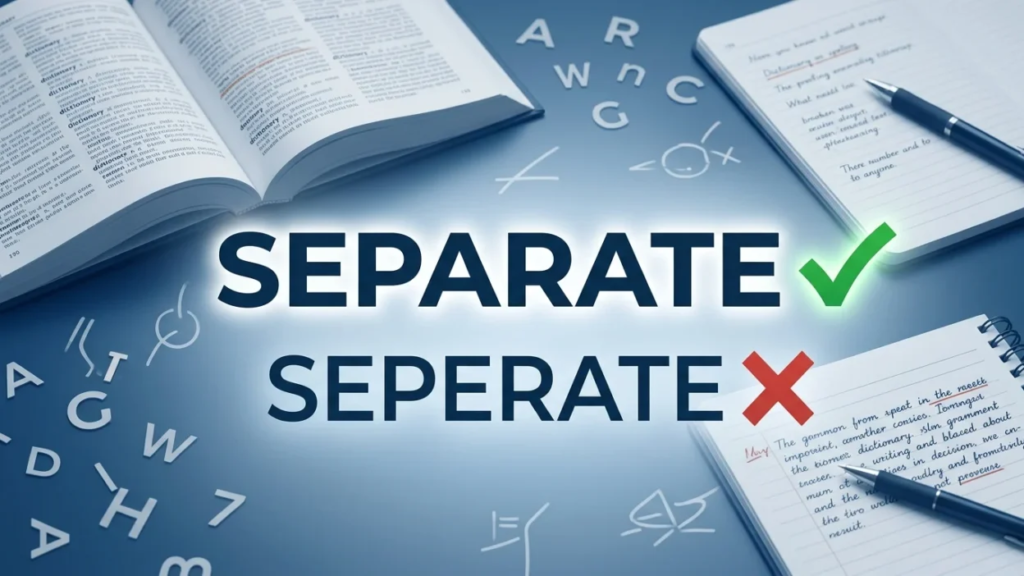
The correct spelling is separate.
The spelling seperate is incorrect in standard English.
This is one of the most common spelling mistakes in English because the word separate does not sound exactly the way it looks. When people say the word quickly, the first vowel can sound weak, which makes it easy to remember the spelling incorrectly. Many writers therefore type “seperate” instead of “separate.”
If you have ever searched for “separate or seperate,” “seperate or separate,” “is it separate or seperate,” or “how to spell separate,” the answer is simple: separate is correct, while seperate is a misspelling.
The word separate can be used as a verb, adjective, and, in some contexts, a noun. It can describe things that are apart, describe the act of moving things apart, or refer to something that is distinct from another thing.
For example:
- Please keep the two documents separate.
- We need to separate the recyclable materials from the trash.
- The children have separate rooms.
- The two companies operate as separate businesses.
The incorrect spelling “seperate” appears frequently in informal writing, online searches, schoolwork, emails, and social media. Although readers usually understand what the writer means, it is still considered a spelling error in standard American English.
Understanding why the mistake happens can make the correct spelling much easier to remember.
The Correct Spelling: Separate
The correct word is separate.
It is spelled:
S-E-P-A-R-A-T-E
A useful way to look at the word is:
sep + ar + ate
The middle “a” is important. The word contains “par” after “se,” which can help you remember the correct sequence.
The incorrect form “seperate” replaces the second “a” with an “e”:
S-E-P-E-R-A-T-E
That small change creates the misspelling.
When writing professionally, academically, or formally, always use separate.
Examples include:
- The files should remain separate.
- We decided to separate the two projects.
- She lives in a separate apartment.
- Put the clean clothes in a separate basket.
- The report has separate sections for each department.
Why Is “Seperate” Incorrect?
“Seperate” is incorrect because it is not the standard spelling of the English word.
Also read:Definitely or Definately: Which One Is Correct?
English spelling does not always follow pronunciation in a simple way. A word may contain a vowel that is not strongly pronounced, especially in everyday speech. That can make people write the sound they hear rather than the letters used in the standard spelling.
The correct spelling is separate, not seperate.
This distinction matters because spelling is part of written communication. A misspelled word can make an otherwise strong sentence look careless or unfinished.
For example:
Incorrect: Please keep the files seperate.
Correct: Please keep the files separate.
Incorrect: The students were seperated into groups.
Correct: The students were separated into groups.
Incorrect: The information is listed seperately.
Correct: The information is listed separately.
The same spelling problem can appear in several related forms of the word. Learning only “separate” is useful, but learning the entire word family is even better.
Separate vs Seperate at a Glance
| Word | Correct? | Explanation |
| separate | Yes | Standard English spelling |
| seperate | No | Common misspelling |
| separated | Yes | Correct past-tense and participle form |
| seperated | No | Misspelling of separated |
| separately | Yes | Correct adverb |
| seperately | No | Misspelling of separately |
| separation | Yes | Correct noun |
| seperation | No | Misspelling of separation |
| separating | Yes | Correct present participle |
| seperating | No | Misspelling of separating |
The key point is that the “a” in separate remains important in related forms.
What Does Separate Mean?
The word separate has several closely related meanings.
At its core, separate means to keep things apart or to make things apart.
As an adjective, separate means existing independently or being apart from something else.
Example:
The two offices have separate entrances.
Here, separate means that each office has its own entrance.
As a verb, separate means to divide, move apart, or cause something to become independent from something else.
Example:
The teacher asked the students to separate into two groups.
As an adverb, separately means individually or apart from something else.
Example:
The items were packaged separately.
As a noun, separate can sometimes refer to an individual item that is distinct from another item. In fashion, for example, “separates” can describe individual clothing pieces that are designed to be worn together or separately.
The central idea remains the same: something is apart, distinct, or divided.
Separate as an Adjective
When separate is an adjective, it describes something that is different, independent, or apart.
Examples:
- We have separate accounts.
- They booked separate hotel rooms.
- The company has separate offices.
- Each student received a separate worksheet.
- The two issues require separate solutions.
- She keeps her personal and professional files separate.
In these sentences, separate describes a noun or describes a condition in which things are not combined.
A useful question to ask is: “Are these things distinct or apart?”
If the answer is yes, separate may be the appropriate word.
Separate as a Verb
Separate can also be a verb.
As a verb, it means to divide, move apart, or cause people or things to become apart.
Examples:
- Please separate the white clothes from the dark clothes.
- The fence separates the two properties.
- The manager separated the documents into categories.
- The road separates the residential area from the commercial district.
- The teacher separated the class into smaller groups.
The past tense is separated.
For example:
- The group separated after lunch.
- The workers were separated into teams.
- The two materials were separated during the process.
Notice that separated keeps the “a” from separate.
This is why “seperated” is also incorrect.
Separate as an Adverb: Separately
The standard adverb form is separately.
Examples:
- The products are sold separately.
- Please submit the documents separately.
- Each issue will be considered separately.
- The guests arrived separately.
- These charges appear separately on your bill.
The misspelled form “seperately” is common because people often apply the same vowel pattern found in “seperate.”
Remember:
separate → separately
Not:
seperate → seperately
Separation Is the Correct Noun
The noun form is separation.
Examples:
- The separation of the two materials was necessary.
- The couple announced their separation.
- There was a clear separation between the two sections.
- The wall provides separation between the rooms.
“Seperation” is a common misspelling.
The correct spelling is:
S-E-P-A-R-A-T-I-O-N
A helpful strategy is to connect the word to separate:
separate → separation
Once you remember the correct base word, many related spellings become easier.
Separating Is Correct
The present participle and gerund form is separating.
Examples:
- She is separating the papers into folders.
- The machine is separating the materials.
- We are separating the recyclable items.
- The teacher is separating the students into groups.
The incorrect spelling “seperating” is another common variation.
The correct relationship is:
separate → separating
Not:
seperate → seperating
Separates Is Also Correct
The third-person singular form of the verb is separates.
Examples:
- The river separates the two regions.
- This wall separates the kitchen from the dining area.
- The software separates the files automatically.
- A fence separates the properties.
The spelling “seperates” is incorrect.
This is another example of why remembering the correct base spelling matters.
Why Do People Confuse Separate and Seperate?
There are several reasons people confuse these two spellings.
Pronunciation Causes Confusion
The pronunciation of separate can make the spelling difficult to remember.
In everyday speech, the middle vowel may be reduced or pronounced less clearly than the spelling suggests. Because English speakers often write words based partly on how they sound, the spelling “seperate” can seem natural.
This is especially true when someone has heard the word many times but has not frequently seen it written.
English Has Many Unpredictable Spellings
English contains many words whose spelling cannot be perfectly predicted from pronunciation.
Consider words such as:
- receive
- believe
- definitely
- necessary
- restaurant
- privilege
People often make mistakes with these words because English spelling contains many historical patterns and exceptions.
Separate belongs to the same general category of words that can be difficult to spell correctly without practice.
The Vowels Sound Similar
The “a” in separate may not sound as strong as people expect when the word is spoken naturally.
This can cause the brain to remember an “e” instead of an “a.”
The result is the familiar typo:
seperate
instead of:
separate
Familiarity With the Misspelling Reinforces It
Another reason is repetition.
If someone repeatedly sees “seperate” online, they may begin to recognize it as familiar. Familiarity can make an incorrect spelling feel correct.
This is why reading high-quality writing can help improve spelling. The more often you see separate written correctly, the more natural the correct form becomes.
How to Remember the Spelling of Separate
One of the easiest ways to remember separate is to focus on the “par” inside the word.
Think:
separate = “there is a par in separate.”
You can visually divide it like this:
SE + PAR + ATE
The important part is PAR.
Another memory trick is:
“There is a rat in separate.”
The letters in “separate” contain R-A-T in sequence:
sepaRATE
This is a popular mnemonic because the word “rat” appears at the end of the spelling sequence.
You can also remember:
“Separate has an A.”
When you are unsure whether the word is separate or seperate, stop and check the middle vowel.
Correct:
separate
Incorrect:
seperate
How to Spell Separate Correctly
If you often ask “how to spell separate,” write it slowly:
S-E-P-A-R-A-T-E
Then say the letters mentally as you type.
A useful practice method is to write the word several times:
separate
separate
separate
separate
separate
Then use it in a sentence:
“I need to keep these files separate.”
This helps connect the spelling with the meaning.
Another good strategy is to learn the word family together:
separate
separates
separated
separating
separately
separation
Seeing the pattern makes it easier to recognize the correct spelling.
Common Misspellings of Separate
The most common misspelling is “seperate.”
However, many other forms appear because people make different typing or spelling errors.
Some examples include:
- seperate
- seperat
- seperated
- seperately
- seperation
- seperating
- seperates
- seprate
- separete
- seperete
- separte
- seperrate
- seperatte
- sepparate
- sepparated
- separeted
- separet
- separetely
- seperatly
- seperatley
- seperatelly
- seperet
- seprated
- seprately
- seprating
- seprates
- separatted
- separatly
- separeted
- separetely
- seperatedly
- seperatingly
- seperatd
- sepertae
- seperta
- separtae
- separted
- separtely
- seperatae
- sepertaed
- seperattee
- separeta
- separetae
- seperrate
- separatte
Some of these are simple typos rather than established alternative spellings. They should not be treated as correct English forms.
For SEO research, spelling-error queries can still be useful because real users may type them into search engines. However, in normal writing, the correct form should always be used.
Seperate, Seperat, and Other Common Errors
The spelling error does not always stop at “seperate.”
Also read:Friend or Freind: Which One Is Correct?
Some people shorten the word accidentally and type “seperat.” Others change the vowel pattern and produce forms such as “separete,” “seperete,” or “seprate.”
These errors can happen because of:
- fast typing
- phonetic spelling
- weak spelling memory
- autocorrect behavior
- unfamiliarity with the word
- keyboard mistakes
- confusion about English vowel patterns
For example:
Incorrect: Please keep the files seperat.
Correct: Please keep the files separate.
Incorrect: The documents are seprate.
Correct: The documents are separate.
Incorrect: Put these in a separete folder.
Correct: Put these in a separate folder.
Seperated vs Separated
A particularly common error is “seperated.”
The correct word is separated.
Incorrect:
The students were seperated into groups.
Correct:
The students were separated into groups.
The reason is simple. The base word is separate.
When adding “-ed,” the spelling becomes:
separate → separated
Not:
seperate → seperated
This is an important spelling pattern because people who make the “seperate” error often carry that error into other forms.
Seperately vs Separately
Another common mistake is “seperately.”
The correct spelling is separately.
Incorrect:
The products are sold seperately.
Correct:
The products are sold separately.
Remember the base word:
separate
Then add the adverb ending:
separately
The “a” remains part of the spelling.
Seperation vs Separation
The correct noun is separation.
Incorrect:
The seperation of the two groups took several minutes.
Correct:
The separation of the two groups took several minutes.
This spelling is especially important in professional, academic, legal, and technical writing.
When in doubt, connect the noun to the base word:
separate → separation
Seperating vs Separating
The correct form is separating.
Incorrect:
The machine is seperating the materials.
Correct:
The machine is separating the materials.
The spelling pattern is:
separate → separating
This same pattern applies to many sentences involving division or distinction.
For example:
- separating colors
- separating files
- separating groups
- separating ingredients
- separating materials
Separate in Everyday American English
Separate is an extremely common word in American English.
You may see it in conversations about:
- families
- schools
- offices
- banking
- shopping
- clothing
- food
- transportation
- technology
- business
- government
- relationships
- education
Examples:
“Please put the receipts in a separate folder.”
“The children have separate bedrooms.”
“We need separate passwords for each account.”
“The restaurant has a separate dining area.”
“The two departments have separate budgets.”
Because the word is so common, learning its correct spelling is worthwhile.
Separate in Formal and Professional Writing
In professional writing, spelling mistakes can affect how readers perceive the writer.
A single typo does not necessarily make information incorrect, but repeated spelling errors can reduce confidence in the document.
The word separate commonly appears in:
- business reports
- emails
- academic papers
- resumes
- instructions
- policies
- contracts
- presentations
- technical documents
- websites
For example:
“We maintain separate records for each department.”
This sounds clear and professional.
By contrast:
“We maintain seperate records for each department.”
The meaning is still understandable, but the spelling error makes the sentence less polished.
Examples of Separate in Sentences
Here are examples showing different uses of separate.
Physical Distance
The two buildings are separated by a narrow road.
Different Categories
Please place the documents in separate folders.
Independent Items
Each customer receives a separate invoice.
Division
The teacher separated the students into three groups.
Independent Responsibilities
The two departments have separate responsibilities.
Personal and Professional Life
It can be helpful to keep personal and professional matters separate.
Products
These accessories are sold separately.
Areas
The kitchen has a separate entrance.
Business Operations
The company operates several separate divisions.
Academic Work
Each question should be answered in a separate paragraph.
Separate and Similar Words
Several words have meanings related to separate.
Apart
Apart means at a distance from each other.
Example:
The two houses are far apart.
Divide
Divide means to split something into parts.
Example:
Divide the class into four groups.
Distinct
Distinct means clearly different or separate.
Example:
The two products have distinct purposes.
Independent
Independent means not controlled or dependent on another person or thing.
Example:
The two businesses are independent companies.
Isolate
Isolate means to keep something apart from others.
Example:
The damaged material was isolated from the rest.
These words are related to separate, but they are not always interchangeable.
Separate vs Divide
Separate and divide can have similar meanings, but they are not identical in every situation.
Separate often emphasizes keeping things apart.
Example:
Separate the red shirts from the blue shirts.
Divide often emphasizes splitting one thing into parts.
Example:
Divide the cake into eight pieces.
The right word depends on what you are trying to express.
Separate vs Distinct
Separate can mean physically or conceptually apart.
Distinct usually emphasizes that something is clearly different.
Example:
The two rooms are separate.
The two ideas are distinct.
Both words can describe differences, but their exact meanings and uses differ.
Separate vs Apart
Apart is commonly used to describe distance or separation.
Example:
The two friends live far apart.
Separate can work as an adjective or verb:
They live in separate houses.
The manager separated the documents.
Knowing the grammar of each word helps you choose the correct one.
Is “Seperate” Ever Correct?
No.
In standard English, seperate is not the correct spelling of the word separate.
If you are writing an email, article, essay, report, resume, school assignment, or professional document, use separate.
The spelling “seperate” may appear in search queries, informal posts, comments, or user-generated content, but its appearance does not make it a standard spelling.
It remains a misspelling.
Why Spell-Check Does Not Always Solve the Problem
Modern spelling tools are useful, but they are not perfect.
Some tools may catch “seperate” immediately. Others may behave differently depending on the application, language settings, dictionary, or context.
Spell-checkers also cannot replace knowledge of word usage.
For example, a system may detect an obviously misspelled word but may not understand every grammatical issue in a sentence.
That is why it is useful to know the correct spelling yourself.
Search Intent Behind “Separate or Seperate”
People searching for “separate or seperate” usually want a quick spelling answer.
Related questions include:
- Is it separate or seperate?
- Is seperate a word?
- How do you spell separate?
- What is the correct spelling of separate?
- Is seperate spelled correctly?
- Why do people spell separate as seperate?
- What is the difference between separate and seperate?
- Is “seperated” correct?
- Is “seperately” correct?
- How do I remember separate?
- What is the spelling of separate?
The answer to all of these questions centers on the same rule: separate is the correct standard spelling, and seperate is incorrect.
Common Search Variations and Misspellings
Searchers may use many different forms when trying to find the correct spelling.
Some common query patterns include:
- separate or seperate
- seperate or separate
- is it separate or seperate
- separate spelling
- seperate spelling
- how to spell separate
- how do you spell separate
- correct spelling of separate
- separate misspelling
- common misspelling of separate
- separate vs seperate
- seperat vs separate
- seprate vs separate
- separete vs separate
- seperated vs separated
- seperately vs separately
- seperation vs separation
- seperating vs separating
- seperatly vs separately
- seperated spelling
These queries reflect the same underlying search intent: determining which spelling is correct.
A Simple Trick for Never Spelling It “Seperate” Again
If you frequently write the word, use one short memory sentence:
“Separate has an A.”
You can also remember:
“There’s a RAT in separate.”
The letters R-A-T appear together near the end:
Also read:Receive or Recieve:Which One Is Correct?
sepaRATE
These memory aids are simple, but repetition is what makes them effective.
Write:
separate
Then:
separated
Then:
separately
Then:
separation
Then:
separating
Seeing the shared spelling pattern makes the correct form easier to remember.
How Teachers Can Explain Separate to Students
Students often learn spelling better when a difficult word is connected to a simple pattern.
A teacher can explain that separate contains “par”:
SE + PAR + ATE
Students can then practice related forms:
separate
separates
separated
separating
separately
separation
A short sentence can reinforce the spelling:
“Keep the papers separate.”
This gives students both the spelling and the meaning.
How Writers Can Avoid the Mistake
Writers can reduce spelling mistakes by building a small proofreading routine.
First, read the document slowly.
Second, search for “seperate.”
If it appears, replace it with “separate.”
Then search for related mistakes such as:
- seperated
- seperately
- seperation
- seperating
- seperates
This is particularly useful when editing long documents.
A personal spelling list can also help. If you repeatedly make the same mistake, add the correct spelling to your practice list.
When to Use Separate in a Sentence
Use separate when you want to communicate that people, objects, ideas, places, groups, or responsibilities are apart or distinct.
For example:
- We need separate rooms.
- Keep these ingredients separate.
- The company has separate divisions.
- Please use a separate form.
- The teacher created separate groups.
- Their responsibilities are separate.
- The charges are listed separately.
The word is natural in both casual and formal American English.
Quick Comparison: Correct and Incorrect Forms
| Incorrect | Correct |
| seperate | separate |
| seperat | separate |
| seperated | separated |
| seperately | separately |
| seperation | separation |
| seperating | separating |
| seperates | separates |
| seprate | separate |
| separete | separate |
| seperete | separate |
| separte | separate |
| seperrate | separate |
| seperatte | separate |
| sepparate | separate |
| sepparated | separated |
| separeted | separated |
| separetely | separately |
| seperatly | separately |
| seprated | separated |
| seprately | separately |
This table shows an important pattern: many spelling errors are simply variations of the same vowel mistake.
What Is the Correct Pronunciation of Separate?
The pronunciation of separate depends somewhat on whether it is being used as a verb, adjective, or noun, and pronunciation can vary by dialect.
In common American English, the verb separate is generally pronounced with a clear emphasis toward the first and final syllables, while the adjective can have a reduced middle sound.
The important point for spelling is that pronunciation should not be used as the only guide.
English spelling often contains letters that are less obvious from everyday speech.
So even if the middle vowel sounds more like an unstressed “uh” or is not strongly heard, the spelling remains separate.
Is Separate a Difficult Word?
For many English learners and native speakers alike, separate is a moderately difficult spelling word.
Its difficulty comes from the difference between pronunciation and spelling, not from its meaning.
The word itself is common and easy to understand.
The challenge is remembering:
separate
rather than:
seperate
Once the spelling pattern becomes familiar, the word is much easier to write correctly.
Why “Seperate” Looks Right to So Many People
The incorrect spelling has a strong visual resemblance to the correct spelling.
Compare:
separate
seperate
Only one letter is different.
This means the eye can easily overlook the mistake, especially when reading quickly.
That is also why proofreading can be difficult. Your brain may automatically recognize what the writer intended and mentally correct the word without noticing the actual letters.
Reading slowly during proofreading can help.
The Most Important Rule to Remember
There is one rule worth remembering above everything else:
The correct spelling is separate, with an “a” in the middle.
Write:
separate
Do not write:
seperate
The same spelling pattern appears in its related forms:
separated
separately
separation
separating
separates
Learning the family is more effective than memorizing one isolated word.
Final Thoughts
The answer to “separate or seperate” is clear: separate is the correct spelling, while seperate is a common misspelling. The mistake usually happens because the pronunciation of separate does not make every letter obvious, and because the two spellings look almost identical. The best way to remember the correct form is to focus on the “a” in separate and practice related words such as separated, separately, separation, separating, and separates. Whether you are writing an email, school assignment, business report, article, or everyday message, choosing separate will give your writing the standard spelling readers expect.
Frequently Asked Questions
Is “seperate” a real English word?
No. “Seperate” is a common misspelling of separate. It is not the standard spelling used in formal English.
What is the easiest way to remember how to spell separate?
Remember that separate contains “par” or use the phrase “There is a RAT in separate.” The key is to remember the “a” rather than replacing it with “e.”
Does the spelling of separate change in British and American English?
The standard spelling separate is used in both American and British English. The pronunciation may vary slightly, but the spelling remains the same.
Can “separate” be used for both people and objects?
Yes. Separate can describe people, objects, places, groups, ideas, responsibilities, documents, and many other things that are apart or distinct.
Why do people often spell separate as “seperate”?
The mistake is mainly caused by pronunciation, similar-looking letter patterns, and the tendency to spell a word according to how it sounds. Because the incorrect form is visually close to the correct one, it can also become familiar through repeated exposure.