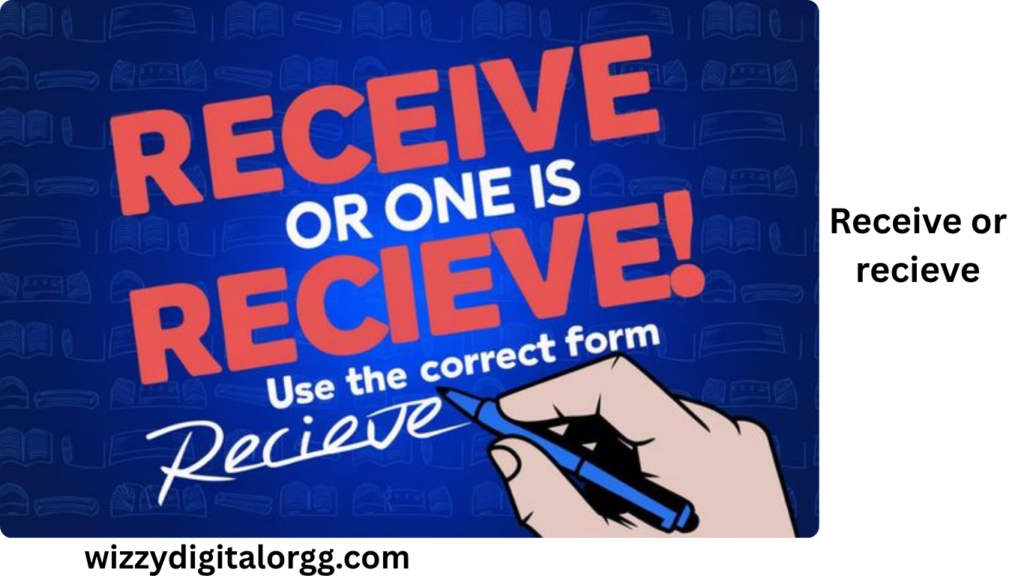
When you are writing an email, school assignment, business message, article, or everyday text, you may pause over one very common English spelling question: Is it “receive” or “recieve”?
The answer is simple: “receive” is the correct spelling, while “recieve” is a common misspelling.
The confusion usually comes from the order of the letters “i” and “e.” English has many words that use both “ie” and “ei,” and learners often remember the familiar spelling rule “i before e except after c.” In the case of “receive,” the word comes after the letter “c,” so the correct sequence is “ei.”
The correct spelling is:
receive
The incorrect spelling is:
recieve
This difference may look small, but it matters in professional and standard English writing. Once you understand the spelling pattern and learn a simple memory trick, “receive” becomes much easier to remember.
This complete guide explains the difference between receive and recieve, including meaning, pronunciation, grammar, sentence examples, related words, common misspellings, and practical ways to remember the correct spelling. It also covers variations such as “recieved,” “recieving,” “reciever,” “receieved,” “recived,” “receve,” “receieve,” “receiv,” “recepient,” and “receipient.”
Receive or Recieve: Which Spelling Is Right?
The correct spelling is:
Receive
The incorrect spelling is:
Recieve
For example:
Correct: I received your email.
Incorrect: I recieved your email.
Correct: Did you receive my message?
Incorrect: Did you recieve my message?
Correct: We will receive the package tomorrow.
Incorrect: We will recieve the package tomorrow.
The main difference is the order of the vowels after the letter “c.”
Correct:
r-e-c-e-i-v-e
Incorrect:
r-e-c-i-e-v-e
The correct spelling contains “ei” after the “c.”
What Does Receive Mean?
“Receive” is a verb that means to get, accept, take delivery of, or be given something.
Also read:Weird or Wierd:Which One Is Correct?
The exact meaning depends on the context.
For example:
“I received a letter.”
This means that a letter was sent to me and I got it.
Another example is:
“Did you receive my email?”
This means:
“Did my email reach you, and did you get it?”
The word can also describe accepting something that is offered or given.
For example:
“She received a gift from her friend.”
Here, “received” means that she was given a gift and accepted or got it.
“Receive” is a very common English verb and appears in everyday conversation, professional communication, business writing, education, technology, customer service, and many other situations.
Receive Meaning in Simple English
In simple English, “receive” means “to get something.”
For example:
“I received a package.”
Means:
“I got a package.”
“You will receive an email.”
Means:
“You will get an email.”
“She received a message.”
Means:
“She got a message.”
Depending on the sentence, “receive” can also mean accept, welcome, experience, or take something that is given.
How Do You Spell Receive?
If you are wondering how to spell receive, the correct spelling is:
R-E-C-E-I-V-E
The most important part to remember is the sequence:
EI
The word can be divided visually as:
RE + CEI + VE
The spelling is:
receive
Not:
recieve
Not:
receve
Not:
receieve
Not:
receiv
A simple spelling check is to look at the letters immediately after “c.”
You need:
c-e-i
not:
c-i-e
How Do You Pronounce Receive?
“Receive” has two syllables.
It is commonly pronounced approximately like:
“ri-SEEV”
The stress is on the second syllable.
The pronunciation does not make the spelling completely obvious because the vowel sounds do not clearly tell you whether the written word contains “ie” or “ei.”
That is one reason “receive” can be misspelled as “recieve.”
When learning the word, it helps to remember both its pronunciation and its visual spelling:
receive
The word sounds like “ri-SEEV,” but the written form must be memorized as R-E-C-E-I-V-E.
Receive vs. Recieve: What Is the Difference?
The difference between receive and recieve is spelling.
| Spelling | Correct? | Meaning |
| receive | Yes | To get, accept, or be given something |
| recieve | No | Common misspelling of receive |
| receve | No | Misspelling |
| receieve | No | Misspelling |
| receiv | No | Incomplete spelling |
| received | Yes | Past tense of receive |
| recieved | No | Common misspelling of received |
| receiving | Yes | Present participle of receive |
| recieving | No | Common misspelling of receiving |
| receiver | Yes | A person or device that receives |
| reciever | No | Common misspelling of receiver |
There is no standard English distinction in which “receive” and “recieve” have different meanings. “Recieve” is normally just an incorrect spelling of “receive.”
Why Do People Confuse Receive and Recieve?
The most common reason is the confusing relationship between “ie” and “ei” in English spelling.
The “I Before E” Rule
Many English learners have heard the traditional rule:
“I before E except after C.”
The rule is often taught to help learners remember words with “ie” and “ei.”
For “receive,” the important part is “except after c.”
The word contains:
c + ei
So:
receive
not:
recieve
The spelling pattern can be remembered as:
“ei after c.”
This is why “receive” is spelled with “ei.”
However, English spelling rules have many exceptions, and the full “i before e” rhyme is not a perfect rule for every English word. It is better to use it as a memory aid rather than as an absolute law.
The Pronunciation Can Be Misleading
When people hear “receive,” they hear a sound similar to “ri-SEEV.”
The sound does not clearly reveal whether the written spelling should be:
receive
or:
recieve
Someone who is spelling from sound may therefore choose the wrong vowel order.
English contains many words where pronunciation alone is not enough to determine spelling.
The Letters Are Easy to Reverse
The difference between “receive” and “recieve” is simply the order of “e” and “i.”
Correct:
ei
Incorrect:
ie
When typing quickly, people can easily reverse the letters.
This is especially common when the person knows the word but has not developed a strong visual memory of its spelling.
The Word Looks Familiar in Both Forms
One of the reasons spelling mistakes are difficult to catch is that an incorrect word can look familiar.
Compare:
receive
recieve
They are visually very similar.
If you read “recieve” quickly, your brain may automatically understand the intended word without noticing the error.
That is why proofreading is important in professional writing.
Is Recieve Correct?
No.
“Recieve” is not the standard spelling of the English verb meaning “to get,” “to accept,” or “to be given.”
The correct form is:
receive
For example:
Correct: “I will receive the documents tomorrow.”
Incorrect: “I will recieve the documents tomorrow.”
The spelling “recieve” is a common mistake, but it should not be used in standard English writing.
Recieve Meaning
If someone searches for “recieve meaning,” they are usually looking for the meaning of “receive.”
“Recieve” does not have a separate standard meaning in modern English. It is simply a misspelling of “receive.”
For example:
“I will recieve the package.”
The intended sentence is:
“I will receive the package.”
Therefore, the useful word to learn is “receive.”
Recieve Spelling
The correct spelling is:
receive
A common incorrect spelling is:
recieve
The easiest way to notice the difference is to focus on the letters after “c.”
Correct:
cei
Incorrect:
cie
So:
receive
not:
recieve
If you repeatedly make this receive spelling mistake, focus on the “cei” sequence.
Receve: Is It Correct?
“Receve” is incorrect when you are trying to spell “receive.”
The missing letter is “i.”
Incorrect:
receve
Correct:
receive
For example:
Incorrect: “Did you receve the package?”
Correct: “Did you receive the package?”
Receve Meaning
“Receve meaning” is generally a spelling-related search rather than a search for a separate English word.
If someone types “receve,” they usually intend “receive.”
The standard English verb is:
receive
Receieve: Is It Correct?
“Receieve” is also incorrect.
This form contains an extra “e” and puts the vowels in the wrong pattern.
Incorrect:
receieve
Correct:
receive
For example:
Incorrect: “I receieve your emails every week.”
Correct: “I receive your emails every week.”
Receieve Meaning
“Receieve” does not have a separate standard English meaning in this context. It is a misspelling of “receive.”
If you see “receieve meaning” in a search query, the person is most likely asking what “receive” means and how it should be spelled.
Receieve Spelling
The correct spelling is:
receive
Not:
receieve
The easiest solution is to memorize the correct word visually instead of trying to build it from sound.
Receiv: Why Is It Incorrect?
“Receiv” is incomplete because it is missing the final “e.”
Correct:
receive
Incorrect:
receiv
For example:
Incorrect: “I will receiv the payment.”
Correct: “I will receive the payment.”
This mistake can happen when someone is typing quickly or is unsure whether the final “e” is required.
Remember:
receive ends with “ve.”
Receive or Recieve: Examples in Sentences
Seeing the correct word in context is one of the best ways to learn it.
Everyday Examples
“I received a text message this morning.”
“Did you receive my email?”
“She received a package from her sister.”
“We receive deliveries every Friday.”
“They will receive their results next week.”
Business Examples
“The customer will receive a confirmation email.”
“You will receive an invoice after the order is processed.”
“We received your application.”
“The company received several complaints.”
“Customers receive free shipping on qualifying orders.”
School Examples
“Students will receive their grades by Friday.”
“She received an award for her project.”
“We received the assignment instructions yesterday.”
Technology Examples
“The server received the request.”
“Your device received a software update.”
“The application received a new message.”
These examples demonstrate why “receive” is such an important English verb.
Receive as a Verb
“Receive” is a verb because it describes an action or state involving getting or accepting something.
Examples:
“I receive emails every day.”
“She receives packages at work.”
“They received the information.”
“He will receive a call later.”
The verb changes form depending on tense and subject.
Receives: Third-Person Singular Form
When the subject is he, she, or it in the simple present, “receive” becomes:
receives
Examples:
“She receives many emails.”
“He receives regular updates.”
“The company receives thousands of orders.”
The spelling is:
receives
Not:
recieves
This is important because the same “ie/ei” confusion can appear in the third-person form.
Received: Past Tense
The past tense of “receive” is:
received
This is one of the most frequently misspelled forms.
Common incorrect versions include:
recieved
recived
receieved
The correct spelling is:
received
Examples:
“I received your message.”
“She received the package yesterday.”
“We received your application.”
“They received the payment.”
Recieved: Common Misspelling
“Recieved” is a very common spelling mistake.
The correct form is:
received
The error happens because the writer changes the vowel order.
Incorrect:
recieved
Correct:
received
The correct sequence after “c” is still:
ei
So:
received
not:
recieved
Recieved Meaning
“Recieved” is not a separate standard English word. It is a misspelling of “received.”
If someone searches for “recieved meaning,” they are generally asking about the correct word “received.”
“Received” means that someone got, accepted, or was given something.
For example:
“I received your letter.”
Recived: Another Common Mistake
“Recived” is incorrect because it leaves out an “e.”
Correct:
received
Incorrect:
recived
For example:
Incorrect: “I recived your email.”
Correct: “I received your email.”
This error often occurs when someone writes the word quickly.
Receieved: Why Is It Wrong?
“Receieved” contains an extra “e” and incorrectly rearranges the vowel pattern.
Correct:
received
Incorrect:
receieved
The correct spelling is easier to remember if you connect it to the base word:
receive → received
The base spelling contains:
cei
The past form retains the same basic sequence:
recei…
Receiving: The Correct -Ing Form
The correct -ing form is:
receiving
Not:
recieving
Not:
recieveing
The spelling changes because the final “e” is removed before adding “-ing.”
The process is:
receive
Remove final “e”:
receiv
Add “-ing”:
receiving
So:
receive → receiving
Examples:
“We are receiving new orders.”
“She is receiving an award.”
“The company is receiving applications.”
Recieving Spelling
“Recieving” is a common misspelling of “receiving.”
Incorrect:
recieving
Correct:
receiving
The error usually happens because the writer reverses the “ei” sequence before adding “-ing.”
Remember the base word:
receive
Then apply the normal spelling change:
receive → receiving
Recieveing: Why Is It Incorrect?
“Recieveing” is another misspelling of “receiving.”
It combines two mistakes:
- “receive” is misspelled as “recieve”
- the “e” is incorrectly retained before “-ing”
Correct:
receiving
Incorrect:
recieveing
For example:
Incorrect: “We are recieveing new orders.”
Correct: “We are receiving new orders.”
Receiver vs. Reciever
“Receiver” is the correct spelling.
“Reciever” is incorrect.
Correct:
receiver
Incorrect:
reciever
A receiver is a person, device, or system that receives something.
For example:
“The receiver accepted the signal.”
In technology, a receiver can be a device that receives information or signals.
In communication, a receiver can be the person who gets a message.
Reciever Meaning
“Reciever” does not have a separate standard English meaning. It is a misspelling of “receiver.”
The correct word is:
receiver
A receiver can be someone or something that receives.
For example:
“The radio receiver picked up the signal.”
Reciever Spelling
The correct spelling is:
receiver
It contains:
ei
not:
ie
So:
receiver
not:
reciever
This follows the same spelling pattern that makes “receive” confusing.
Recepient vs. Recipient
“Recepient” and “receipient” are common spelling mistakes related to the word “recipient.”
The correct spelling is:
recipient
A recipient is a person who receives something.
Also read:Protection or Protction:Which One Is Correct?
For example:
“The recipient received the award.”
“Recipient” is related in meaning to “receive,” but its spelling must be learned separately.
Incorrect:
recepient
Incorrect:
receipient
Correct:
recipient
This is a useful distinction because people sometimes assume that every word related to “receive” should preserve the exact same spelling pattern.
Receive or Recieve: Which One Should You Use?
Always use:
receive
when you mean “get,” “accept,” or “be given.”
Examples:
“I hope you receive my message.”
“You will receive your order tomorrow.”
“We received your application.”
“Did you receive the invitation?”
Do not use:
recieve
in standard writing.
Receive or Recieve in American English
For US English, the correct spelling is:
receive
American English does not use “recieve” as an alternative spelling.
For example:
“The customer will receive an email.”
This spelling is appropriate in American business communication, educational writing, websites, reports, and everyday messages.
Receive or Recieve in British English
British English also uses:
receive
There is no standard British spelling “recieve.”
Therefore, this is one spelling issue that does not change between American and British English.
The pronunciation can vary somewhat between accents, but the spelling remains:
receive
Why Correct Spelling Matters
A misspelling such as “recieve” may be understandable, but correct spelling makes communication more professional.
Spelling matters especially in:
- business emails
- resumes
- cover letters
- school assignments
- professional reports
- website content
- marketing materials
- legal documents
- customer communication
For example, compare:
“We will recieve your application soon.”
with:
“We will receive your application soon.”
The second version looks polished and professional.
A single typo may not be serious, but repeated spelling mistakes can reduce a reader’s confidence in the quality of the writing.
Receive in Professional Communication
“Receive” is extremely common in business English.
Examples include:
“You will receive a confirmation email.”
“We have received your request.”
“Please confirm that you received the document.”
“Customers will receive an order confirmation.”
“You should receive your payment within five business days.”
These phrases appear frequently in customer service, finance, sales, administration, and online services.
Receive in Technology
Technology uses “receive” in many contexts.
A computer can receive data.
A phone can receive a message.
A server can receive a request.
A device can receive a signal.
An application can receive an update.
Examples:
“The server received the request.”
“The phone cannot receive the signal.”
“The application receives data from the device.”
Because “receive” is so common in technology, knowing the correct spelling is especially useful for technical writers and digital professionals.
Receive in Everyday Conversation
People use “receive” constantly in ordinary English.
Examples:
“Did you receive my text?”
“I received your package.”
“When did you receive it?”
“Did you receive the invitation?”
“I haven’t received anything yet.”
These sentences are simple, natural, and common.
Receive vs. Get
“Receive” and “get” can sometimes communicate the same basic idea.
For example:
“I received a package.”
“I got a package.”
Both can mean that a package came to me.
However, “receive” often sounds more formal or neutral than “get.”
In casual conversation:
“I got your email.”
In professional communication:
“I received your email.”
Both are correct, but the tone is different.
Receive vs. Accept
“Receive” and “accept” are also related but do not always mean exactly the same thing.
“Receive” focuses on getting something.
“Accept” focuses on agreeing to take or approve something.
For example:
“I received the gift.”
This tells us that the gift came to me.
“I accepted the gift.”
This emphasizes that I agreed to take it.
A person can receive something without necessarily accepting it in every sense.
Receive vs. Take
“Receive” can also differ from “take.”
If someone sends you a package, you receive it when it reaches you.
If you physically take it, you are emphasizing the action of picking it up or carrying it.
For example:
“I received the package yesterday.”
“I took the package upstairs.”
The verbs describe different parts of the situation.
Common Phrases With Receive
Some common phrases include:
- receive a message
- receive an email
- receive a package
- receive payment
- receive an award
- receive information
- receive support
- receive an invitation
- receive a response
- receive permission
- receive treatment
- receive feedback
- receive a call
- receive a notification
- receive a refund
These expressions show how flexible the word is.
Receive Payment
“Receive payment” is common in business and financial English.
For example:
“The company received payment from the customer.”
This means the company got the money.
Another example:
“You will receive payment within seven business days.”
This means the person will get the money within that period.
Receive an Award
“Receive an award” means to be given an award or honor.
For example:
“She received an award for her work.”
“He received a scholarship.”
“They received recognition for their efforts.”
Receive Feedback
“Receive feedback” means to get comments, opinions, or suggestions about your work or performance.
For example:
“Employees receive feedback from their managers.”
“The student received helpful feedback on the assignment.”
This phrase is especially common in professional and educational settings.
Receive an Invitation
If someone sends you an invitation, you can say:
“I received an invitation.”
For example:
“I received an invitation to the wedding.”
The word “receive” emphasizes that the invitation reached you.
Receive Information
Another common expression is:
“receive information”
Examples:
“Customers receive information by email.”
“The system receives information from the sensor.”
“We received new information about the project.”
How to Remember Receive
A simple memory trick can make the spelling much easier.
Remember “C Before EI”
The word contains:
C + EI
So think:
“After C, use EI.”
This gives:
receive
not:
recieve
This connects naturally with the traditional spelling reminder “i before e except after c.”
Remember the Middle: CEI
Look at the center of the word:
CEI
The spelling is:
R E C E I V E
If you can remember “CEI,” you can avoid the most common mistake.
Use the Phrase “Receive Has EI After C”
Repeat this mentally:
“Receive has EI after C.”
Then spell:
r-e-c-e-i-v-e
This is a simple memory cue for students and English learners.
How to Avoid the Receive Spelling Mistake
If you often type “recieve,” try these habits.
First, slow down when typing the word.
Second, look specifically at the “ei” sequence.
Third, remember the phrase:
“ei after c.”
Fourth, learn the related forms together:
receive
received
receiving
receiver
This creates a stronger spelling pattern in your memory.
A Simple Receive Spelling Test
Ask yourself:
Does the word contain “cei”?
If yes:
receive
If you see “cie”:
recieve
That quick visual check can help you catch the error before submitting your writing.
Common Receive Spelling Mistakes
Here are the most important forms to avoid:
Incorrect: recieve
Correct: receive
Incorrect: receve
Correct: receive
Incorrect: receieve
Correct: receive
Incorrect: receiv
Correct: receive
Incorrect: recieved
Correct: received
Incorrect: recived
Correct: received
Incorrect: receieved
Correct: received
Incorrect: recieving
Correct: receiving
Incorrect: recieveing
Correct: receiving
Incorrect: reciever
Correct: receiver
Incorrect: recepient
Correct: recipient
Incorrect: receipient
Correct: recipient
Correct and Incorrect Sentence Examples
Correct:
“Did you receive my email?”
Incorrect:
“Did you recieve my email?”
Correct:
“I received your message.”
Incorrect:
“I recieved your message.”
Correct:
“We are receiving new applications.”
Incorrect:
“We are recieving new applications.”
Correct:
“He is the receiver of the signal.”
Incorrect:
“He is the reciever of the signal.”
Correct:
“The recipient received the award.”
Incorrect:
“The recepient recieved the award.”
These examples show how several related spelling errors can occur in one sentence.
A Quick Comparison Table
| Incorrect Form | Correct Form |
| recieve | receive |
| receve | receive |
| receieve | receive |
| receiv | receive |
| recieved | received |
| recived | received |
| receieved | received |
| recieving | receiving |
| recieveing | receiving |
| reciever | receiver |
| recepient | recipient |
| receipient | recipient |
The safest strategy is not to memorize every incorrect version. Instead, learn the correct forms well enough that the mistakes look unfamiliar.
Why “Receive” Is a Commonly Misspelled Word
“Receive” is common enough that people type it frequently, but its spelling contains a vowel sequence that can be confusing.
The combination “ei” appears in many words, but English does not always use it consistently.
Compare:
receive
deceive
conceive
perceive
But:
believe
field
piece
The different patterns can make English spelling difficult.
The good news is that “receive” belongs to a useful family of words with a similar “cei” pattern.
Words Similar to Receive
Several common words use a similar spelling pattern:
- deceive
- conceive
- perceive
- receive
- deceive
- receipt
- ceiling
These words can help reinforce the “ei after c” pattern.
For example:
receive
deceive
perceive
conceive
This does not mean every word containing “c” follows exactly the same rule, but it provides a useful spelling pattern.
Also read:Uncuymaza: Meaning, Origins, Cultural Ideas, Modern Uses, and Why the Term Is Gaining Attention
Receive and Receipt
“Receipt” is closely related to “receive” and can create another spelling challenge.
Correct:
receipt
Common mistake:
reciept
The letters “ei” appear after “c” in both:
receive
receipt
This relationship can help reinforce the pattern.
For example:
“I received the receipt.”
Both words use the “cei” pattern.
Receive and Deceive
“Deceive” follows a similar pattern:
d-e-c-e-i-v-e
Compare:
r-e-c-e-i-v-e
The spelling pattern is almost identical after the first letter.
Remembering “deceive” can therefore help some learners remember “receive.”
Receive and Perceive
“Perceive” is another word with “ei” after “c.”
Correct:
perceive
Not:
percieve
This is another useful example of the same spelling pattern.
Receive and Conceive
“Conceive” is also spelled with “ei” after “c.”
Correct:
conceive
Not:
concieve
Learning related words can make the spelling pattern easier to recognize.
Is Receive a Formal Word?
Yes.
“Receive” is a standard English word and is appropriate in both formal and informal communication.
For example:
Formal:
“We have received your application.”
Informal:
“I received your text.”
The word itself is not overly formal. The surrounding sentence determines the overall tone.
Receive in Academic Writing
“Receive” is common in academic writing.
Examples:
“Students receive feedback from instructors.”
“Participants received written instructions.”
“The samples received further analysis.”
“The study received approval.”
Because the word is precise and standard, it can be used comfortably in academic contexts.
Receive in Business Writing
Business communication uses “receive” constantly.
Examples:
“We received your request.”
“You will receive a confirmation email.”
“Customers receive a receipt after payment.”
“Please confirm that you received the document.”
Using the correct spelling is particularly important in these contexts because business writing should be clear and professional.
Search Intent Behind Receive or Recieve
A person searching “receive or recieve” is usually looking for a quick spelling answer.
They may also want to know:
- Which spelling is correct?
- Why is “recieve” wrong?
- What does receive mean?
- How do you pronounce receive?
- How do you spell receive?
- Why do people write recieve?
- What is the past tense of receive?
- How do you spell receiving?
- What is the correct spelling of receiver?
A useful explanation should answer these questions naturally rather than simply stating that one spelling is correct.
SEO and Natural Use of Misspelled Keywords
Searchers may type misspellings such as “recieve,” “recieved,” “recieving,” or “reciever” because they are unsure about the correct spelling.
It is useful to mention these variations when explaining the spelling problem, but they should not be repeated unnaturally.
The goal of a helpful article is to answer the reader’s question clearly.
For example, instead of repeatedly writing “recieve meaning” throughout an article, it is better to explain once that “recieve” is a misspelling and then discuss the actual meaning of “receive.”
This keeps the writing natural and useful.
How to Spell Receive Correctly Every Time
Use this simple process:
- Start with “re.”
- Add “ce.”
- Add “i.”
- Add “ve.”
That produces:
re + ce + i + ve
receive
The most important sequence is:
cei
If you remember “cei,” you are much less likely to write “recieve.”
Receive Spelling Memory Trick
Here is a short memory sentence:
“After C, receive uses EI.”
Think:
C + EI
Then:
receive
This is more useful than trying to memorize a long spelling rule.
Another visual trick is:
RECEIVE
The “EI” appears immediately after “C.”
You can mentally highlight:
REC-EI-VE
This makes the spelling pattern easier to see.
Final Answer: Receive or Recieve?
The correct spelling is:
Receive
The incorrect spelling is:
Recieve
If you mean “to get,” “to accept,” or “to be given something,” use “receive.”
For example:
“I will receive the package tomorrow.”
The common misspelling “recieve” has the “i” and “e” in the wrong order.
Correct:
receive
Incorrect:
recieve
The same spelling pattern appears in related words such as “received,” “receiving,” and “receiver,” although each form follows its own grammatical spelling rule.
Other common errors include “receve,” “receieve,” “receiv,” “recieved,” “recived,” “receieved,” “recieving,” “recieveing,” and “reciever.”
If you are unsure how to spell receive, remember:
EI after C
That gives you:
R-E-C-E-I-V-E
Once this pattern becomes familiar, you will be much less likely to make the receive spelling mistake.
Final Thoughts
“Receive” is the correct spelling, while “recieve” is a common spelling mistake. The confusion mainly comes from the “ie” and “ei” letter combinations and the fact that English spelling cannot always be predicted perfectly from pronunciation. A simple way to remember the correct form is to focus on the “ei” after the letter “c”: receive. The same pattern can help with related words such as “received,” “receiving,” and “receiver.” Whether you are writing an email, school assignment, business document, website article, or everyday message, using “receive” will keep your writing accurate, clear, and professional.
FAQs About Receive and Recieve
Is “recieve” ever acceptable in standard English?
No. “Recieve” is normally considered a misspelling of “receive.” Standard English uses “receive” for the verb meaning to get, accept, or be given something.
Why do people write “recieve” instead of “receive”?
The main reason is confusion between the letter sequences “ie” and “ei.” People may also reverse the letters while typing quickly or rely too heavily on pronunciation.
What is the correct past tense of receive?
The correct past tense is “received.” Common incorrect forms include “recieved,” “recived,” and “receieved.”
What is the correct spelling of the person who receives something?
The correct word is “receiver.” “Reciever” is a common misspelling.
What is the difference between “receive” and “accept”?
“Receive” focuses on getting or being given something, while “accept” usually emphasizes agreeing to take, approve, or welcome something. The two words can overlap in some situations but are not always interchangeable.