When writing in English, some words are easy to spell while others seem to create confusion every time you type them. One of the most common examples is the choice between “weird” and “wierd.” The two spellings look almost identical, and they contain the same letters. However, the order of two letters makes a major difference.
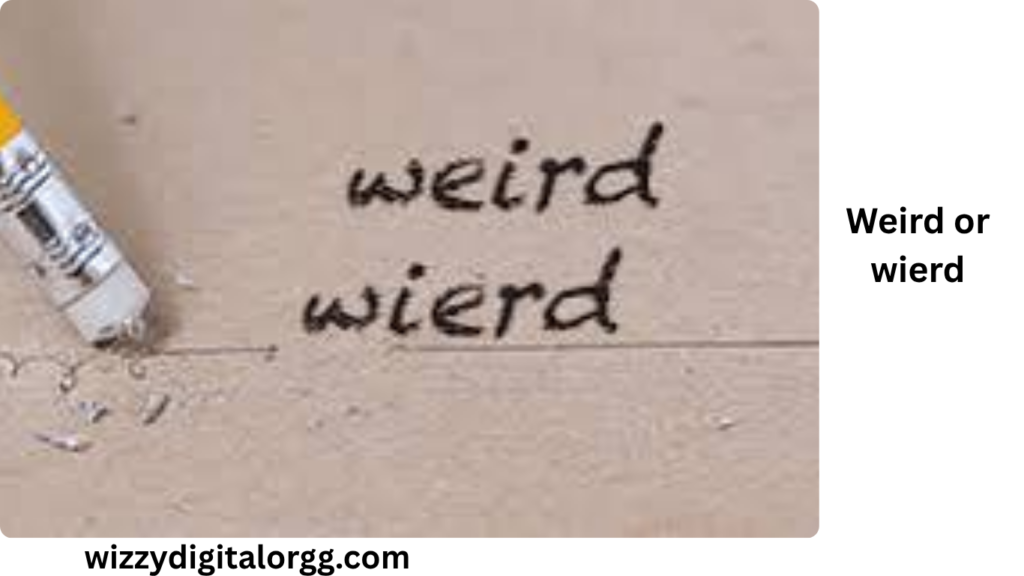
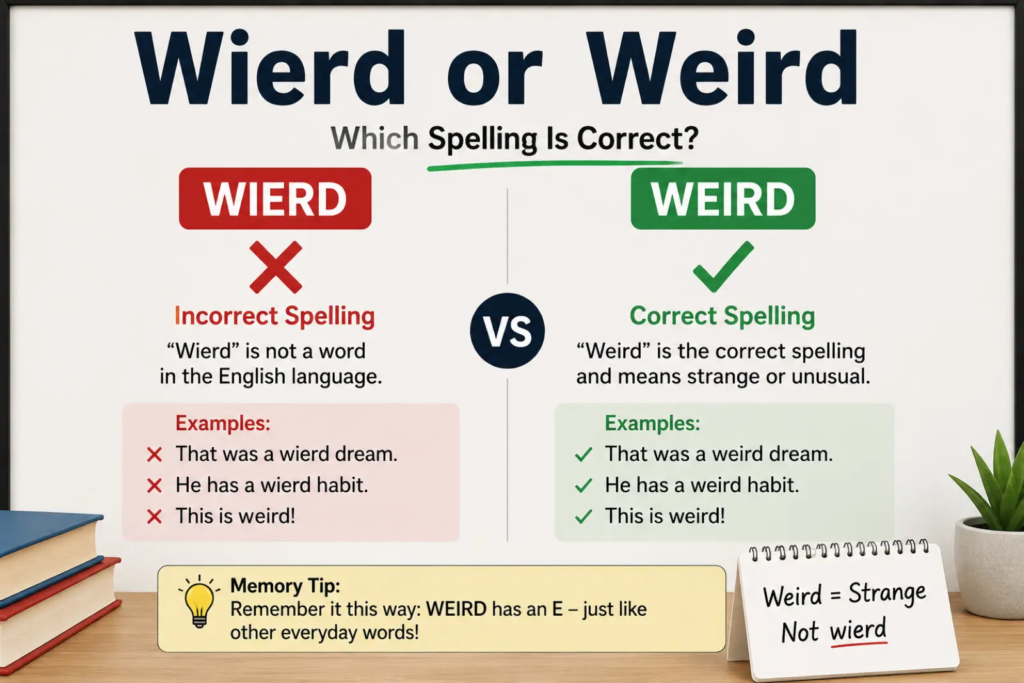
The correct spelling is weird.
Wierd is an incorrect spelling and is generally considered a misspelling of weird.
This mistake is especially interesting because the usual English spelling rule “i before e except after c” can make people hesitate. The word weird does not follow that simple pattern. It contains “ei,” which is one reason people may accidentally write wierd instead.
If you have ever searched for “wierd meaning,” “wierd spelling,” “wierd or weird,” or “how to spell weird,” you are not alone. Many people know exactly what the word means but pause when they need to write it.
This guide explains the difference between weird and wierd in simple English. It covers the correct spelling, meaning, definition, pronunciation, grammar, examples, common misspellings, related searches, and practical memory tricks. It also explains why people write wierd and how to avoid this common spelling mistake.
Weird vs Wierd: Understanding the Correct Spelling
The correct spelling is weird.
The incorrect spelling is wierd.
Here is the simple comparison:
| Spelling | Correct? | Explanation |
| Weird | Yes | Standard English spelling |
| Wierd | No | Common misspelling of weird |
For example:
Correct: That was a weird experience.
Incorrect: That was a wierd experience.
Correct: He has a weird sense of humor.
Incorrect: He has a wierd sense of humor.
Correct: I heard a weird noise outside.
Incorrect: I heard a wierd noise outside.
If you are deciding between weird or wierd, choose weird.
What Does Weird Mean?
The word weird is an adjective.
The basic meaning of weird is something strange, unusual, unexpected, or different from what is normal.
For example, if someone tells you a story that seems very unusual, you might say:
“That is weird.”
If you hear a strange sound in an empty room, you might say:
“That was a weird noise.”
The word can describe people, situations, behavior, objects, experiences, sounds, feelings, ideas, or events.
Also read:Uncuymaza: Meaning, Origins, Cultural Ideas, Modern Uses, and Why the Term Is Gaining Attention
The meaning can be negative, neutral, humorous, or even positive depending on context and tone.
Weird Definition in Simple English
A simple weird definition is:
Weird means strange, unusual, unexpected, or different from what is normally expected.
For example:
A strange dream can be weird.
An unusual sound can be weird.
An unexpected situation can be weird.
A person behaving unusually may be described as weird.
The word does not always mean something bad. In casual American English, people often use weird to describe something surprising or unusual without intending an insult.
Weird Meaning in English
The weird meaning in English depends on the situation.
In everyday conversation, weird often means strange or unusual.
For example:
“That movie was weird.”
Here, weird suggests that the movie was unusual or difficult to understand.
Someone might also say:
“That is a weird coincidence.”
In this sentence, weird means unusually surprising.
Another example is:
“My computer is acting weird.”
Here, weird means that the computer is behaving in an unusual way.
Therefore, weird can have several shades of meaning.
Wierd Meaning
People who search for “wierd meaning” are usually trying to understand the word weird.
Wierd is not the standard spelling.
The intended word is normally weird.
For example:
“I had a wierd dream.”
The corrected sentence is:
“I had a weird dream.”
The meaning does not change because of the spelling mistake. However, the spelling should be corrected in professional, academic, and published writing.
Wierd Definition
There is no standard English definition for wierd because wierd is not the accepted spelling of the adjective.
If you are looking for a wierd definition, you are most likely looking for the definition of weird.
The correct word describes something strange, unusual, unexpected, or outside what is considered normal.
Wierd Spelling vs Weird Spelling
The difference between the two forms is only the order of “i” and “e.”
Correct:
W-E-I-R-D
Incorrect:
W-I-E-R-D
The correct spelling has “ei” after the “w.”
The incorrect spelling has “ie.”
This small difference causes a surprisingly large amount of confusion.
Why Do People Spell Weird as Wierd?
There are several reasons people write wierd.
The first is the familiar English spelling rule involving “i” and “e.”
Many English learners hear or remember the phrase:
“I before E except after C.”
This can encourage someone to write wierd because the word appears to contain the letters i and e.
However, weird is one of the words that does not fit that simple rule.
Another reason is pronunciation. The vowel sound in weird does not always make the spelling obvious.
A third reason is visual memory. Wierd looks natural to many people because it resembles other English words containing “ie.”
Finally, people often type quickly and make simple letter-order mistakes.
The “I Before E” Rule and Weird
The “i before e except after c” rule is often taught to English learners.
It can be useful in some situations, but it has many exceptions.
Weird is one of the famous examples that can cause trouble.
The correct spelling is:
Weird
not:
Wierd
This means that relying entirely on the simple “i before e” rule can lead to an incorrect spelling.
The safest approach is to memorize the spelling of weird as a special case.
How to Spell Weird
If you are asking how to spell weird, the answer is:
W-E-I-R-D
The correct word is:
Weird.
A simple way to remember it is to focus on the middle letters:
WEI
Think:
W-E-I-R-D
not:
W-I-E-R-D.
Once you learn this pattern, the spelling becomes much easier.
How Do You Spell Weird?
If someone asks, “How do you spell weird?” spell it:
W-E-I-R-D.
You can remember it by connecting the spelling to the phrase:
“Weird has E before I.”
This is not a general spelling rule. It is simply a memory trick for this particular word.
Another useful trick is to remember that weird begins with “we,” which is followed by “ir.”
We + ir + d = weird.
Correct Spelling of Weird
The correct spelling of weird is:
Weird.
The word contains:
W
E
I
R
D
The most common mistake is switching the positions of E and I.
Correct:
WEIRD
Incorrect:
WIERD
If you are writing a formal document, always use weird.
Is Wierd Correct?
No.
Wierd is not the standard spelling of the word.
It is a common misspelling of weird.
If you write:
“That sounds wierd.”
You should correct it to:
“That sounds weird.”
The meaning is understandable, but the spelling is incorrect.
Is Weird Correct?
Yes.
Weird is the standard and correct English spelling.
It is used in American English and other varieties of English.
Examples include:
That is weird.
This is a weird situation.
I heard a weird noise.
He had a weird dream.
The movie was weird but interesting.
Wierd or Weird: Which Should You Use?
When deciding between wierd or weird, use weird.
The correct comparison is:
Weird = correct
Wierd = incorrect
The difference is the position of the letters E and I.
A simple visual reminder is:
WEIRD
The E comes before I.
Weird or Wierd: Which Is Correct?
The answer to “weird or wierd” is weird.
This is true in standard American English.
If you see the spelling wierd online, it is generally a typo or spelling mistake.
For professional writing, use weird.
Weird vs Wierd
The weird vs wierd comparison is straightforward.
Weird is a valid English adjective.
Wierd is a common misspelling.
The two words are not different vocabulary terms with different meanings.
Instead, wierd is normally an incorrect version of weird.
Wierd vs Weird
The reverse comparison, wierd vs weird, gives the same result.
Weird is correct.
Wierd is incorrect.
The letters are arranged differently:
WEIRD
WIERD
Only the second and third letters differ, but that difference determines whether the spelling is correct.
Weird Pronunciation
The common American English pronunciation of weird is approximately:
weerd
The International Phonetic Alphabet commonly represents it as /wɪrd/ in American English.
The pronunciation can vary somewhat between English varieties.
The word is generally pronounced as one syllable.
This is important because the spelling may look more complicated than the pronunciation sounds.
Wierd Pronunciation
Because wierd is not a standard English word, it does not have a separate standard pronunciation.
When people write wierd, they normally intend weird.
Therefore, if you are searching for “wierd pronunciation,” the appropriate pronunciation to learn is the pronunciation of weird.
Why Weird Pronunciation Can Cause Spelling Mistakes
The spelling and pronunciation of weird do not perfectly match what many learners might expect.
The word is short, but its vowel arrangement is unusual.
Someone may hear the word and remember only the “weerd” sound.
When they later try to write it, they may choose:
Wierd
because that letter arrangement feels natural.
The best solution is to learn the spelling separately from the sound.
Is Wierd a Word?
In standard modern English, wierd is generally treated as a misspelling rather than the correct spelling of the adjective weird.
If you see “wierd” in a text, the intended word is almost certainly weird.
For standard writing, use weird.
Is Wierd a Correct Word?
No, not as the standard spelling of the adjective meaning strange or unusual.
The correct word is weird.
Therefore:
Wierd = misspelling
Weird = correct
Is Weird a Word?
Yes.
Weird is a standard English word.
It is commonly used as an adjective to describe something strange, unusual, unexpected, or unconventional.
Examples:
That is a weird idea.
The weather is weird today.
I had a weird dream.
The situation became weird quickly.
Weird as an Adjective
Weird is an adjective.
An adjective describes a person, place, thing, or situation.
For example:
A weird sound
A weird movie
A weird idea
A weird experience
A weird person
A weird situation
In each example, weird describes the noun that follows it.
Weird Used in a Sentence
Here are natural examples of weird used in a sentence:
The movie had a weird ending.
I heard a weird noise in the kitchen.
That is a weird question.
She had a weird dream last night.
This weather feels weird today.
He has a weird sense of humor.
The conversation became weird after that comment.
My phone is acting weird.
These examples show how commonly the word appears in everyday English.
Weird Example Sentences
Here are more weird example sentences:
The old house had a weird smell.
That was a weird coincidence.
I had a weird feeling about the situation.
The machine made a weird sound.
He told us a weird story.
The website displayed a weird message.
The situation became weird very quickly.
The movie was weird but entertaining.
She found a weird object in the garden.
The dog was acting weird this morning.
Weird Meaning in Different Situations
The meaning of weird can change slightly depending on context.
Weird Meaning as Strange
This is the most common meaning.
Example:
That is a weird-looking building.
Here, weird means unusual or strange.
Weird Meaning as Unexpected
Weird can describe something surprising.
Example:
It was weird to see him there.
The speaker did not expect to see him.
Weird Meaning as Uncomfortable
Sometimes weird describes an uncomfortable feeling.
Example:
The silence felt weird.
Here, weird suggests that the situation felt unusual or uncomfortable.
Weird Meaning as Funny or Unusual
In casual speech, weird can sometimes be playful.
Example:
My brother has a weird sense of humor.
This does not necessarily mean something is bad.
Weird Synonyms
Common weird synonyms include:
Strange
Unusual
Odd
Uncommon
Unconventional
Bizarre
Abnormal
Peculiar
Eccentric
Unexpected
Not all of these words have exactly the same emotional meaning.
For example, strange can be neutral, while bizarre may suggest something much more unusual.
Weird Synonyms in Everyday English
In casual American English, people often use:
Odd
Strange
Unusual
Funny
Different
Bizarre
For example:
“That is weird.”
could become:
“That is strange.”
“That is odd.”
“That is unusual.”
The best synonym depends on the situation and tone.
Weird Opposite
Possible weird opposites include:
Normal
Ordinary
Usual
Typical
Common
Expected
Conventional
For example:
The situation was weird.
The situation was normal.
These two sentences express contrasting ideas.
Weird Antonym
A common weird antonym is normal.
Other possible antonyms include ordinary, usual, typical, and conventional.
Again, context matters.
For example:
A weird behavior
A normal behavior
An unusual event
A typical event
Weird Spelling Mistake
The most common weird spelling mistake is writing wierd.
This happens when the writer switches E and I.
Correct:
Weird
Incorrect:
Wierd
This is a simple letter-order mistake.
Also read:Slylar Box: A Complete Guide to the AI Tools, Software, Apps, and Online Services Platform
Wierd Spelling Mistake
A wierd spelling mistake is usually just another way of describing the same error.
If someone writes:
“That’s wierd.”
the sentence should be:
“That’s weird.”
The mistake does not necessarily show that the writer does not understand the word. It may simply be a spelling or typing error.
Weird Misspelling
The most common misspelling of weird is wierd.
Other less common variations may include:
Weired
Weard
Wiered
Weerd
Weirdd
These forms can result from different types of spelling or typing mistakes.
Wierd Misspelling
Wierd is itself a misspelling of weird.
It is one of the most recognizable incorrect forms because it looks extremely close to the correct word.
This is why searches for “wierd spelling” and “wierd or weird” are common among people checking their writing.
Weird Typo
A weird typo can happen when the writer accidentally switches letters.
For example:
WEIRD → WIERD
This can happen quickly when typing.
Another possible typo is:
WEIRD → WEIRDD
Here, an extra D has been added.
Proofreading can catch these errors.
Wierd Typo
Wierd can be considered a common typo or misspelling when someone intends to write weird.
If you notice wierd in your document, replace it with weird.
Weird Incorrect Spelling
If you are looking for the weird incorrect spelling, the most common one is:
Wierd
But it is important to understand the direction correctly.
Weird is not incorrect.
Wierd is incorrect.
Wierd Incorrect Spelling
Wierd is an incorrect spelling of weird.
The problem is the order of the vowel letters.
Correct:
E-I
Incorrect:
I-E
Remember:
WEIRD
not:
WIERD.
Weird Wrong Spelling
The phrase weird wrong spelling may refer to the common mistake of writing wierd.
The correct spelling is still weird.
Wierd Wrong Spelling
Wierd is the wrong spelling when you mean the standard English adjective weird.
For professional writing, correct it before publishing or submitting your work.
Common Misspelling of Weird
The most common misspelling of weird is wierd.
Other possible forms include:
Weired
Weard
Wiered
Weerd
Weirdd
Among these, wierd is by far the most recognizable because it results from reversing the “ei” sequence.
Common Weird Spelling Mistake
The common weird spelling mistake happens because writers expect the word to follow familiar “ie” spelling patterns.
The correct sequence is:
WEI
The incorrect sequence is:
WIE
This tiny difference is the main reason for the mistake.
Weard Meaning
Weard is not the standard spelling of the adjective weird.
If someone searches for “weard meaning,” they may be looking for weird.
In modern standard English, use weird when you mean strange or unusual.
Weard Spelling
Weard is an incorrect spelling when intended as the adjective weird.
Correct:
Weird
Incorrect:
Weard
The spelling changes the letters after “we.”
Weard or Weird
If the choice is weard or weird, choose weird.
Weird is the standard English spelling.
Weard is not the standard spelling of the adjective.
Weird or Weard
The answer to weird or weard is weird.
For example:
Correct: That sounds weird.
Incorrect: That sounds weard.
Weired Meaning
Weired is another possible misspelling.
If someone searches for “weired meaning,” they are usually trying to find the meaning of weird.
The correct spelling is weird.
Weired should not be used as the standard spelling of the adjective.
Weired Spelling
Weired adds an extra “e” to the word.
Correct:
Weird
Incorrect:
Weired
This may happen because someone tries to make the pronunciation easier to represent.
Weired or Weird
The correct choice is weird.
Weired is not the standard spelling.
Therefore:
Weird = correct
Weired = incorrect
Wiered
Wiered is another nonstandard spelling that may appear when people are unsure about the correct letter sequence.
If the intended word means strange or unusual, use weird.
Wiered Meaning
The phrase wiered meaning generally points toward the intended word weird.
Wiered is not the standard spelling of that adjective.
Correct:
Weird
Incorrect:
Wiered
Wiered Spelling
Wiered contains the same basic letters as weird but adds an extra “e” and changes their arrangement.
This makes it a spelling error rather than a standard alternative.
Weirdd
Weirdd is another obvious typing mistake.
The standard spelling has one final D:
Weird
not:
Weirdd
This type of error can happen when a writer accidentally presses a key twice.
Weerd
Weerd is another spelling variation that people may type because the pronunciation of weird sounds similar to “weerd.”
However, when you mean strange or unusual, the standard spelling is weird.
Weerd Meaning
If you search for “weerd meaning,” you may be looking for weird meaning.
In ordinary modern English, use weird for the adjective meaning strange or unusual.
Weerd Spelling
The standard spelling is weird.
Weerd is not the standard spelling of the adjective.
This is an example of a phonetic spelling mistake, where someone writes the word according to how it sounds.
Weerd or Weird
The correct choice is weird.
Correct:
That is weird.
Incorrect:
That is weerd.
Weerd vs Weird
Weerd and weird may look similar in pronunciation, but weird is the standard spelling.
If your sentence means strange or unusual, choose weird.
Weard vs Weird
The correct form is weird.
Weard is not the standard spelling of the adjective.
This is another example of why spelling from pronunciation can cause problems.
Weired vs Weird
Weird is correct.
Weired is incorrect when intended to mean strange or unusual.
The extra “e” makes the word different from the standard spelling.
Wiered vs Weird
Weird is correct.
Wiered is a misspelling.
The safest approach is to memorize the five-letter form:
W-E-I-R-D.
How to Remember Weird Spelling
The easiest way to remember weird spelling is to memorize:
W-E-I-R-D
A useful personal memory trick is:
“Weird has E before I.”
Again, this is only a memory aid. It should not be treated as a universal English spelling rule.
Another method is to associate weird with the word “we.”
Start with:
WE
Then:
IR
Then:
D
Together:
WE + IR + D = WEIRD.
Easy Way to Spell Weird
The easiest way to spell weird is to remember that the middle letters are E-I.
Write:
WEI
Then add:
RD
The result is:
WEIRD.
Avoid automatically writing WIERD because it looks familiar.
Why Is Wierd Spelled Wrong?
Wierd is spelled wrong because the standard English spelling places E before I.
Also read:MyAnonamouse: Complete Guide to the Private Ebook and Audiobook Tracker
Correct:
WEIRD
Incorrect:
WIERD
The letters have been switched.
The intended meaning is usually still understandable, but the spelling is not standard.
Why Do People Spell Weird Wierd?
People spell weird as wierd for several reasons.
The biggest reason is probably confusion about the order of E and I.
The familiar “i before e” pattern can also influence people.
Pronunciation may contribute as well.
Typing quickly is another common cause.
Finally, some people may have seen the misspelling many times online and unconsciously remembered it as correct.
Why Is Weird Spelled Weird?
The spelling of weird comes from the historical development of the English word.
Modern English contains many words whose spellings reflect older forms and historical changes.
That means there is not always a simple modern spelling rule that explains every letter.
For everyday writing, the most useful approach is simply to remember the standard form:
Weird.
Weird in American English
Weird is widely used in American English.
It is common in casual conversation, entertainment, social media, journalism, and general writing.
Examples include:
That movie was weird.
I had a weird dream.
This is a weird situation.
The weather has been weird lately.
The word is informal enough for everyday conversation but can also appear in professional writing when the context is appropriate.
Weird in Formal Writing
Weird can be used in formal writing, but the writer should consider the tone.
For example:
“The researchers observed an unusual pattern.”
may be more appropriate in a scientific report than:
“The researchers observed a weird pattern.”
In casual writing, weird is completely natural.
In formal writing, words such as unusual, unexpected, irregular, or unconventional may sometimes be more precise.
Weird in Casual Conversation
In everyday American English, weird is extremely flexible.
Someone might say:
“That is weird.”
“This tastes weird.”
“My computer is acting weird.”
“That guy is kind of weird.”
“That was a weird coincidence.”
The meaning changes slightly with context.
Weird Can Be Positive or Negative
Weird does not always mean something bad.
For example:
“That artist makes weird but interesting paintings.”
Here, weird can mean unusual and creative.
Similarly:
“She has a weird sense of humor.”
This may be a friendly description rather than a serious criticism.
Tone and context are important.
Is Weird an Insult?
Sometimes.
Calling a person weird can sound insulting if it is said negatively.
However, friends may use weird playfully.
For example:
“You are weird, but that’s why you’re fun.”
The meaning depends heavily on tone, relationship, and context.
When writing professionally, unusual or unconventional may be more appropriate when you want to avoid sounding judgmental.
Weird and Strange
Weird and strange are close synonyms.
For example:
That is weird.
That is strange.
Both can mean that something is unusual.
However, weird is often more conversational and informal.
Weird and Unusual
Unusual is generally more neutral.
Compare:
That is weird.
That is unusual.
The first may express surprise or discomfort.
The second sounds more objective.
This difference can matter in professional writing.
Weird and Odd
Odd is another common synonym.
For example:
That is an odd idea.
That is a weird idea.
Both sentences suggest something unusual.
Odd can sometimes sound slightly more neutral.
Weird Word Meaning and Grammar
The word weird functions mainly as an adjective.
It can appear before a noun:
A weird sound
A weird person
A weird idea
A weird experience
It can also appear after linking verbs:
The sound was weird.
The situation seemed weird.
The movie felt weird.
Weird Word Examples
Here are some additional examples:
The room had a weird atmosphere.
I noticed a weird pattern.
That is a weird question.
The story has a weird ending.
Something weird happened yesterday.
He made a weird face.
The app showed a weird error.
She heard a weird noise.
These examples demonstrate how widely the word can be used.
Common Search Questions About Weird
People may search for:
What does weird mean?
What is weird?
Weird meaning
Weird definition
How to spell weird
How do you spell weird?
Wierd meaning
Wierd spelling
Wierd or weird
Weird or wierd
Is wierd correct?
Is weird correct?
Why do people spell weird as wierd?
These searches all point toward the same basic information: the correct spelling is weird.
Weird vs Wierd: Quick Comparison
| Feature | Weird | Wierd |
| Correct spelling | Yes | No |
| Standard English word | Yes | No |
| Part of speech | Adjective | Misspelling |
| Meaning | Strange or unusual | No separate standard meaning |
| Pronunciation | Standard pronunciation | Usually intended as weird |
| US English | Yes | No |
| Common online typo | No | Yes |
Common Weird Spelling Errors
The following forms should generally be corrected when they are intended to mean weird:
Wierd
Weired
Weard
Wiered
Weirdd
Weerd
These forms may appear because of letter reversal, added letters, phonetic spelling, or typing mistakes.
The standard form is always:
Weird.
Why Correct Spelling Matters
A spelling mistake may not always prevent someone from understanding your meaning, but correct spelling makes writing easier to read and more professional.
This is especially important in:
School assignments
Business emails
Resumes
Websites
Blog posts
Guest posts
Reports
Marketing materials
Academic writing
Professional communication
Using weird instead of wierd shows that you know the standard spelling of the word.
How to Avoid the Weird Spelling Mistake
There are several simple ways to avoid the mistake.
First, memorize the five letters:
W-E-I-R-D.
Second, remember that E comes before I in this word.
Third, connect the word to familiar sentences:
That is weird.
This sounds weird.
I had a weird dream.
Fourth, use a spell checker when proofreading longer documents.
Finally, if you regularly make the same mistake, write the correct spelling several times until it becomes familiar.
Weird or Wierd: Final Spelling Rule
When you see weird or wierd, remember one simple fact:
Weird is correct.
Wierd is incorrect.
The correct sequence is:
WEI
not:
WIE.
You do not need to overthink the spelling every time you use the word. Once you memorize this five-letter pattern, the correct spelling becomes much easier.
Conclusion
When choosing between weird and wierd, the correct spelling is weird. Wierd is a common misspelling caused mainly by confusion over the order of the letters E and I, the pronunciation of the word, the familiar “i before e” spelling pattern, or simple typing mistakes. Weird is a standard English adjective meaning strange, unusual, unexpected, or unconventional, and it is widely used in American English. If you are wondering how to spell weird, remember the five-letter pattern W-E-I-R-D and focus on the middle E-I sequence. Searches such as wierd meaning, wierd spelling, wierd or weird, weird or wierd, correct spelling of weird, and how do you spell weird all lead to the same answer: use weird. Other forms such as weired, weard, wiered, weirdd, and weerd are also incorrect when the intended word is weird. Once you remember that the correct spelling is WEIRD, this common spelling mistake becomes much easier to avoid.
Frequently Asked Questions
Why is the spelling “weird” unusual in English?
The word uses “ei” instead of the “ie” pattern many learners expect, which makes it easy to misspell as wierd.
Is “weird” used differently in American and British English?
The word is used in both varieties of English, although pronunciation can vary slightly between accents.
Can weird describe a good thing?
Yes. In casual English, weird can describe something unusual, creative, funny, or unexpectedly interesting.
Is weird suitable for professional writing?
Yes, but context matters. In highly formal writing, words such as unusual, unexpected, or unconventional may sometimes be more precise.
What is the fastest way to check whether you spelled weird correctly?
Look at the middle letters. The correct form is WEIRD, with E before I.